Waterloo, 1974: the three minutes that changed Eurovision
ABBA won in Brighton, and every entry since has been quietly measured against what happened next.
The short answer
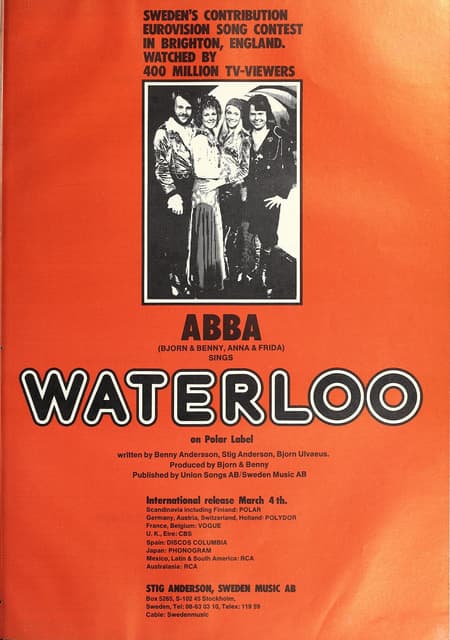
ABBA won the Eurovision Song Contest in 1974 in Brighton with "Waterloo", representing Sweden — the country's first victory, and the launch of the most commercially successful career ever to come out of the contest.
Every argument about what Eurovision is for traces back to one evening in Brighton in April 1974.
Why Brighton
Luxembourg won in 1973 and, having hosted the year before, declined to pay for it again. Hosting was already expensive enough that a small broadcaster could win and then ask someone else to stage it — a problem the contest has never fully solved, and the same arithmetic that made Ireland uncomfortable two decades later.
The BBC took it on and the contest went to the Brighton Dome.
The entry
Sweden sent a group performing under their own names for the first time, with a song about surrender as a romantic metaphor, arranged as glam rock rather than as a Eurovision ballad. They wore satin and platform boots. The conductor wore a Napoleon costume.
None of that was normal. Eurovision in 1974 was a light-entertainment showcase for national broadcasters, and the standard entry was orchestral, sincere and sung by someone standing still.
"Waterloo" was a pop record. It was built to be a hit outside the contest, which almost nothing in the field was, and it sounded like the radio rather than like the show.
The result
Sweden won — its first victory, of what are now seven. The United Kingdom's jury gave "Waterloo" no points at all, a detail that has outlived almost everything else about that night.
Why it still matters
ABBA became the most commercially successful act ever to emerge from Eurovision, by a distance that is difficult to overstate, and that created a belief the contest has been living with ever since: that Eurovision can launch a global career.
It very rarely does. A small number of acts have used it as a genuine springboard — Céline Dion, who won for Switzerland in 1988, is the other obvious case — but the overwhelming majority of winners return to a domestic career. The exception became the expectation.
That expectation is why countries agonise over selection, why "is this a Eurovision song or a real song" is a question fans argue about every year, and why a broadcaster sending something deliberately safe attracts genuine anger. Everyone is measuring against Brighton.
The Swedish consequence
Sweden took the lesson more seriously than anyone. Melodifestivalen grew into a six-week national institution and a functioning songwriting industry, and Sweden has since won seven times and become a net exporter of songs to other countries' entries.
The country that turned a single win into a system is the same one that got the win by treating the contest as a pop competition rather than a broadcasting obligation. See most Eurovision wins for where that has left the record books.
FAQ
What year did ABBA win Eurovision?
1974, in Brighton, representing Sweden with "Waterloo". It was Sweden's first Eurovision victory.
Why was Eurovision 1974 held in the United Kingdom?
Luxembourg won in 1973 but declined to host again on cost grounds, having staged the contest the previous year. The BBC stepped in and the contest was held in Brighton.
Did the United Kingdom give ABBA any points in 1974?
No. The United Kingdom jury awarded "Waterloo" nothing, which became one of the contest's most repeated pieces of trivia.