Sofia: what it is actually like
A capital with a mountain at the end of the street and Roman ruins under the metro station.
The short answer
Sofia is Bulgaria's capital and largest city, sitting at the foot of Vitosha mountain. It bid to host Eurovision 2027 and lost to Burgas on 13 August 2026, but it is where most visitors will land and the easiest base for the rest of the country.
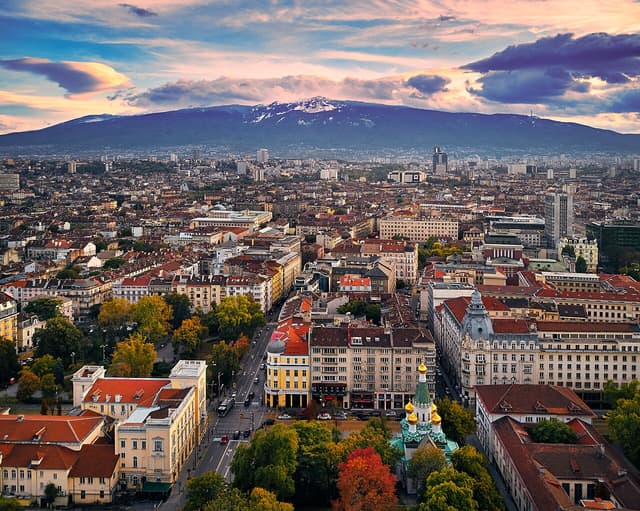
Sofia does not sell itself. It has no skyline, no single postcard view, and it makes a poor first impression from a taxi window. It is also one of the more interesting capitals in Europe once you stop waiting for it to look like one.
The mountain
Vitosha rises directly behind the city and is inside the municipal boundary. From the centre you can be at a trailhead in half an hour on public transport, and on a clear winter day the city has a snow-covered mountain at the end of its main shopping street.
No other EU capital has this relationship with a mountain. It is the thing residents would name first and the thing visitors notice last.
The Roman layer
Sofia is built on Serdica, and the city has stopped pretending otherwise. When the metro was extended, the excavation hit a Roman street grid — and rather than removing it, the station was built around it. You now change trains through an open archaeological site at Serdika, walking on Roman paving on the way to platform level.
The Church of St George, a fourth-century rotunda, sits in a courtyard surrounded by government buildings and a hotel. It is the oldest building in the city and it is still in use.
What to actually see
- Alexander Nevsky Cathedral — the gold-domed one on every photo of Bulgaria. Genuinely enormous, and free to enter.
- Vitosha Boulevard — the pedestrian spine, with the mountain framed at the end of it. This is where the city goes to be seen.
- The National Palace of Culture (NDK) — a vast socialist-era congress centre at the end of a long park axis. Architecturally divisive and the single best place to understand what the city was built to be.
- The Largo and the Presidency — monumental Stalinist-era architecture, with the changing of the guard on the hour.
- Central Market Hall and the Women's Market — the covered hall for the building, the open market for the produce and the noise.
Eating
Bulgarian food is Balkan food with a strong dairy habit, and Sofia does it very well and very cheaply. Look for shopska salad, tarator in summer, grilled meat, and banitsa from a bakery in the morning. The wine is genuinely underrated: Bulgaria has native grape varieties — mavrud, melnik, rubin — that exist almost nowhere else, and a bottle of something good costs what a glass costs elsewhere in the EU.
Getting around
The metro is the answer to most journeys. Two lines through the centre, one connecting the airport, cheap flat-fare tickets, and trains that arrive. Trams and buses fill the gaps and are older and slower.
The city is walkable in the centre and not beyond it. Pavements are uneven and parked cars treat them as an extension of the road; this is the most common complaint from visitors and it is fair.
As a Eurovision host
Sofia has the airport capacity, the hotel stock, the arena, the international connections and the broadcaster's own headquarters. On infrastructure, it is the straightforward choice.
What it does not have is a story. Burgas is bidding as a Black Sea summer city, which is a much better television proposition and a much worse logistics one. That tension is the whole host city decision, and we track it on the host city page — including what each city has formally committed and what remains a press quote.
FAQ
Is Sofia worth visiting?
Yes, and for a specific reason: it is a European capital where a serious mountain, a Roman city and a functioning modern metro are all within twenty minutes of each other, at a fraction of western European prices.
How do I get from Sofia Airport to the city centre?
The metro runs from Terminal 2 to the centre and takes around twenty minutes for the price of a single ticket. It is faster and cheaper than a taxi in traffic.
Will Sofia host Eurovision 2027?
No. BNT and the EBU chose Burgas on 13 August 2026. Sofia remains the main international gateway and the easiest base for the rest of the country.